The Challenge
A rental network this size operates differently from an OEM. Headquarters runs a fleet console that ingests live telemetry from every asset in the field — utilisation, battery state, fault codes — and uses that data to schedule service, balance utilisation between depots, and settle warranty arguments.
For that to work, the charger has to feed into the console too. Most chargers don't. They expose data over a local interface only — Bluetooth on a good day, a wired port on a worse one. To change a charge curve, send an updated algorithm, or pull a charge history, somebody has to go to the depot, find the machine, and touch the unit. Across 200+ depots, that's a logistics problem the back office can't carry.
Field firmware updates carry the same overhead. When a charger needs a profile change for a new battery generation, the standard answer is a service truck visit. The network couldn't ramp new battery chemistries through the fleet at the pace the asset planning needed.
The Solution
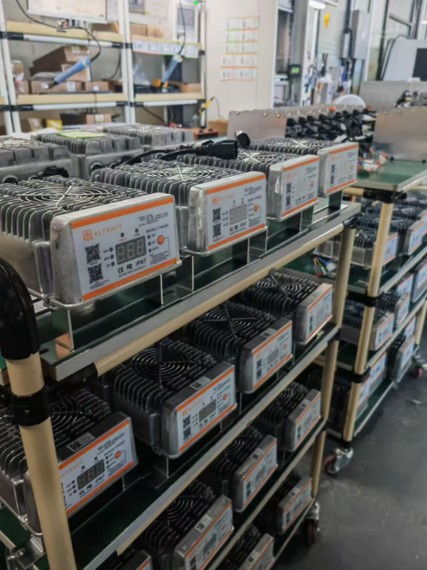
The ALT Series ships with cloud-connected telemetry and over-the-air firmware as native features, not bolted-on integrations. The rental network's fleet console pulls charge logs, fault codes, and state-of-charge data live across the depot footprint, and pushes algorithm updates to chargers without dispatching a technician.
For the network's headquarters, that means three workflows that previously involved a truck now run from a desk:
Live fleet visibility. Every charger reports current cycle, recent history, and any fault state into the console. Service tickets get raised on the data, not on a customer call from the depot.
Remote profile tuning. When a battery generation rotates through the fleet, headquarters pushes the matching charge profile to the relevant chargers across the affected depots. The depot doesn't have to know about the change.
OTA firmware. Charger firmware updates — bug fixes, new safety logic, new algorithm libraries — ship over the air. The unit reboots in the field, and the network is back at the current revision the next day.
Deployment
Chargers roll into the network as depots cycle machines through service. Each new charger comes online in the fleet console as soon as it's deployed, so the data layer is built up depot by depot rather than as a single switch-over.
The Result
The network's headquarters reads the fleet from one screen. Charge history, fault state, and current configuration for every charger across the depots is available without a phone call to a site manager.
Service truck rolls are no longer the default response to a charger question. Most adjustments are pushed from HQ. Truck rolls are reserved for the work that actually needs hands on the machine.
New battery chemistries reach the field at planning speed instead of dispatch speed. When the asset team rotates a new pack supplier into the fleet, the matching charge profile ships with it, over the air, on the same schedule.